Key Takeaways
As WhatsApp conversations grow, AI Agents and chatbots help businesses handle repetitive inquiries, respond faster, and keep support teams from being overwhelmed.
WhatsApp AI Agents are suited to context-aware, open-ended conversations, while chatbots work better for predefined tasks such as FAQs, lead capture, and guided workflows.
Before choosing a WhatsApp AI Agent or chatbot, compare knowledge base capabilities, human handoff, integrations, scalability, multilingual support, and pricing to find a solution that fits your workflow.
Why Do Businesses Need More Than Manual Support on WhatsApp?
WhatsApp creates a shorter path for businesses and customers to connect and build ongoing communication, but keeping every conversation on track is another story. As a business grows, messages can quickly pile up—from product questions and order updates to support requests and sales inquiries. And when customers expect quick replies, catching up with all of them manually is often easier said than done.
Handling every conversation by hand can put a lot of pressure on customer support teams. Agents may spend much of their day answering the same questions, jumping between conversations, and trying to stay on top of new messages. Outside business hours, there may not even be anyone around to pick up the conversation. That doesn't mean human support is going away. Far from it. Human agents are still essential when customers need empathy, good judgment, or help with an issue that doesn't fit neatly into a predefined process. The real problem is having people spend their time on questions that could be answered in seconds.
That's where AI can take some of the pressure off. AI-powered agents or chatbots can handle routine conversations, answer common questions, provide information, and manage initial interactions. When a conversation gets more complicated, a human agent can step in and take over. The idea behind it isn't to replace people with AI. It's about letting each do what they do best: AI handles the repetitive work, while people focus on the conversations that need a human touch.
WhatsApp AI Agent vs. Chatbot: What's the Difference?
WhatsApp AI Agents and chatbots can both take some work off a business's plate. They can answer customer questions, share product or service information, collect contact details, and handle routine support requests. Where they differ is how they go about it.
Powered by AI, WhatsApp AI Agents can better understand what a customer is asking, follow the context of the conversation, and respond based on business information, knowledge bases, and available customer data. Instead of sticking to a fixed script, they can provide more relevant answers based on customer context, keep track of what has already been discussed, and adjust their responses as the conversation moves along. That makes AI Agents a good fit for more open-ended conversations. A customer might ask a follow-up question, change direction halfway through a conversation, ask for a product recommendation, or need help with a more specific issue. See our guide on WhatsApp AI Agents for a closer look.
WhatsApp chatbots, on the other hand, take a more structured route. They usually rely on predefined rules, keywords, buttons, menus, or conversation flows. When a customer selects an option or triggers a specific keyword, the chatbot follows the corresponding path and delivers the response that has been set up. That structure can be a plus. Chatbots work well when questions are simple, predictable, and easy to map out—for example, answering FAQs, collecting customer details, sharing basic information, or walking someone through a specific process.
Simply put, chatbots follow the flow, while AI Agents can follow the conversation. But it’s not really a case of one replacing the other. Both can handle routine customer interactions; they just take a different approach. Chatbots work best when you already know where the conversation is going, while AI Agents are more useful when customers can go off-script and the interaction needs a little more flexibility.
What Should Businesses Look for in a WhatsApp AI Agent or Chatbot?
Knowing the difference is one thing. Picking the right tool is another. With so many WhatsApp AI Agents and chatbots offering similar features, it can be hard to tell which ones will actually work for your business. The right choice comes down to more than whether a tool can answer customer messages—it also needs to fit your workflows and make sense for your budget and growth plans.
Here are some things worth checking before making a decision:
WhatsApp integration and scalability
Start with the basics: how does the tool connect to WhatsApp, and does it work with the WhatsApp Business Platform? It's also worth checking how easily you can add phone numbers and team members, or handle higher message volumes as your business grows.Knowledge base
The quality of an AI Agent depends heavily on the information behind it. Look for support for product catalogs, FAQs, policies, documents, and other business content, with an easy way to update that information when things change.CRM and channel integrations
If WhatsApp is only one part of your customer communication, check whether the platform can connect with your CRM and other channels. Bringing customer data and conversations together makes it easier to keep track of leads, follow up with customers, and manage interactions across different touchpoints.Automation capabilities
Look beyond individual replies and consider what happens next. A good platform may let you qualify leads, recommend products, send follow-ups, or trigger actions in other systems as part of a larger workflow.Team collaboration
If multiple people handle the same WhatsApp account, collaboration features can make a big difference. Shared inboxes, conversation assignments, internal notes, and permissions can help your team stay organized without adding another layer of admin.Multilingual support
For businesses serving customers in different markets, language support can be a deciding factor. Check which languages the AI can understand and respond in, and whether it can switch between languages naturally during a conversation.Analytics and reporting
Useful reporting should tell you more than how many messages were sent. Metrics such as lead conversion, response performance, common customer questions, and AI resolution rates can help you see what's working and where there's room for improvement.Pricing and usage limits
Pricing can be based on users, conversations, messages, contacts, AI usage, or a combination of these. Rather than comparing monthly prices at face value, look at what's included and how the cost may change as your message volume grows.
Top 10 WhatsApp AI Agents & Chatbots in 2026
1. SaleWisely
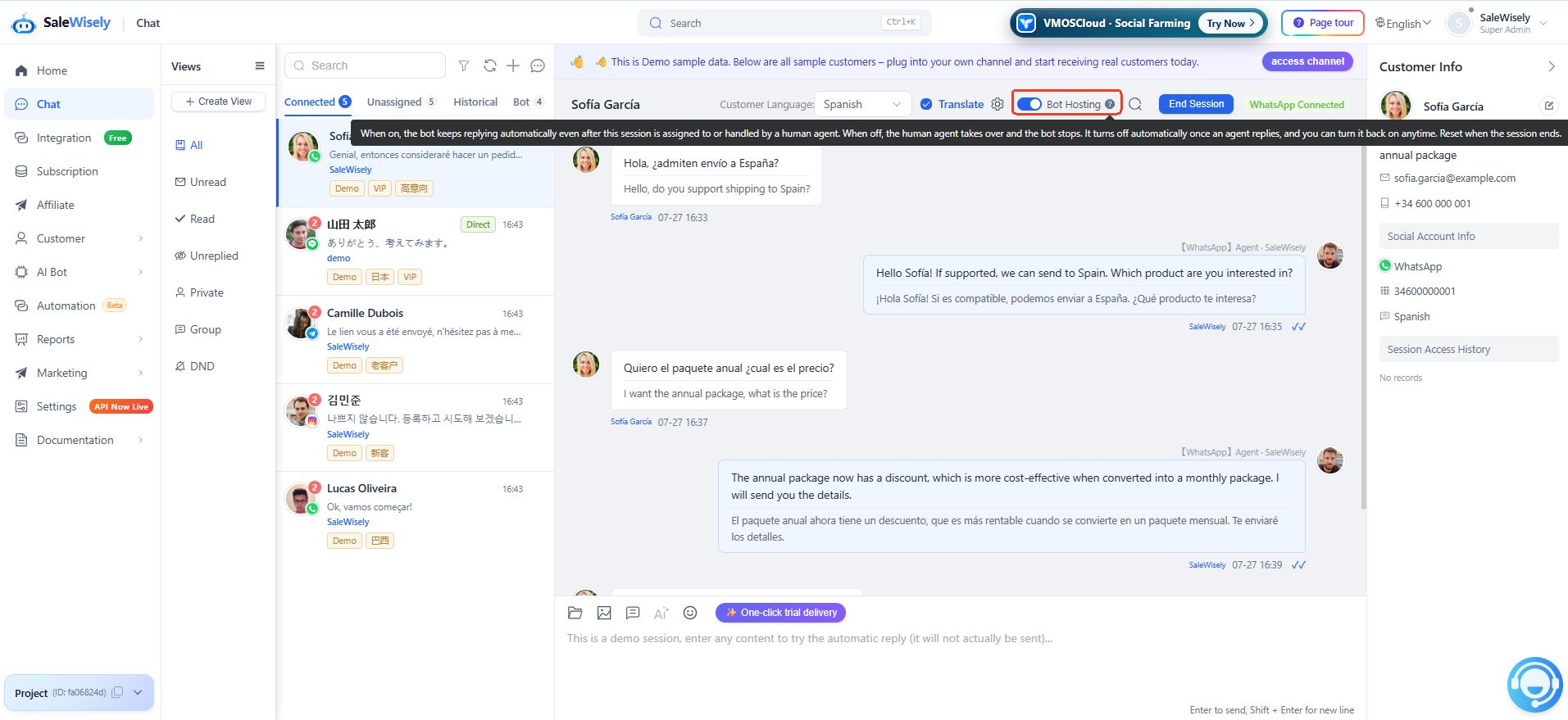
SaleWisely is an AI customer conversation management platform that helps businesses manage omnichannel conversations including WhatsApp from one place. Beyond handling customer messages, it brings together AI Agents, CRM, team collaboration, real-time translation, and workflow automation, so businesses can manage the broader customer journey instead of simply responding to chats. Its LLM-powered AI Agent can understand customer intent and answer questions with the knowledge base. When a conversation needs a human touch, it can be handed over to a team member with the relevant context attached.
Key features:
LLM-powered AI Agent: Understands customer intent and handles open-ended conversations rather than following fixed scripts.
Knowledge base + RAG: Uses product information, help docs, FAQs, and past conversations to ground AI responses in business-specific knowledge.
Human + AI workflow: AI can hand conversations to human agents when needed, with a conversation summary attached. Human-edited responses can also be used to improve future AI interactions.
Team collaboration: Shared conversations, assignments, and internal collaboration tools help multi-agent teams work together efficiently.
Real-time translation: Helps teams communicate with customers in different languages without having to switch between separate translation tools.
Omnichannel chat: Brings WhatsApp and other 30+ channels(e.g. Telegram, LINE, Instagram, Facebook, TikTok etc.) into a unified inbox.
CRM integration: Connects customer conversations with CRM data to help teams manage leads, customer profiles, and follow-ups.
Pricing:
SaleWisely offers free channel integrations, cloud-hosted accounts and team seats, with no limits on conversations or monthly active contacts. The only paid component is AI credits, used when AI translates, replies, or automation. AI can be switched off anytime, and new accounts can get 10,000 AI credits free.
Best for:
Businesses looking for an all-in-one solution to manage WhatsApp and broader channels with advanced AI support.
2. Respond.io
Respond.io is a customer conversation platform built for handling high-volume messages. It gives businesses a central place to capture conversations, qualify prospects, route chats, and keep customer information updated across WhatsApp, TikTok, Instagram, Facebook, and voice.
Key features:
No-code AI Agent builder: Build and test AI Agents without coding, using business knowledge and custom instructions to handle customer conversations.
Human handoff : Understand customer intent, qualify leads, answer questions, generate summaries, and route conversations to the right team or specialized AI Agent.
Real-time business actions: Update CRM fields and lifecycle stages, trigger workflows, add internal comments, and connect with external systems through APIs to check orders, bookings, or customer data during conversations.
AI voice and multimodal support: Handle WhatsApp and VoIP calls, as well as text, images, PDFs, and voice messages, with human handoff when needed.
Omnichannel inbox: Manage WhatsApp, TikTok, Instagram, Facebook, Telegram and other channels from one shared inbox.
CRM: Native HubSpot and Salesforce integrations.
Pricing:
AI Agents are available on the Growth plan and above. Costs start at $199/month, with pricing scaling based on the number of users beyond the fixed seats included in plan.
Best for:
Mid-market B2C businesses require a multi-channel workplace and advanced automation support.
3. Twilio
Twilio takes a different route from ready-made WhatsApp chatbot platforms. It provides the APIs and communication infrastructure developers need to build their own customer messaging experiences. WhatsApp can sit alongside SMS, voice, and other channels, while businesses can connect those conversations to their own AI models, CRM, databases, and internal systems.
Key features:
AI agent integration: Connect AI models or agents to Twilio and deploy them across WhatsApp, voice, SMS, chat, and other channels.
Real-time AI actions: AI agents can understand customer intent, retrieve information, take actions, and help resolve requests during live conversations.
Persistent customer context: Maintain customer memory across interactions so conversations can continue without starting from scratch.
Omnichannel communication: Connect WhatsApp, SMS, voice, RCS, chat, and other communication channels within the same platform.
AI-human collaboration: Route conversations between AI and human agents while preserving conversation history, context, summaries, and next-best actions.
Developer-friendly infrastructure: APIs and programmable building blocks allow technical teams to connect AI with CRMs, databases, internal systems, and custom workflows.
Pricing:
Twilio uses a pay-as-you-go pricing model, with costs based on the products and services you use. WhatsApp, SMS, voice, Conversations, AI capabilities, customer data, and developer tools are priced separately, with rates varying by product, usage, and sometimes use case. For example, WhatsApp messaging starts at $0.005 per message, while Conversation Relay starts at $0.07/minute.
Best for:
Businesses with developer resources that need customizable AI-powered customer experiences across multiple communication channels.
4. Tidio
Tidio comes from the customer support and live chat side of the market, with Lyro AI Agent at the center of its automation features. Lyro uses a business's knowledge base to answer customer questions, handle routine support requests, and keep conversations moving, while human agents can step in when a conversation needs more attention.
Key features:
Knowledge-based AI Agent: Lyro uses your support content and knowledge base to provide answers grounded in your business information.
Human handoff: Set flexible handoff rules so support agents can take over conversations, particularly when customers need personalized help or the topic is sensitive.
Real-time monitoring: Teams can monitor Lyro conversations and jump in whenever human assistance is needed.
Performance analytics: Track resolution rates, customer satisfaction, and conversation patterns to identify gaps and improve AI support.
Integrations: Connect with Zendesk, Intercom, Salesforce, and 20+ other platforms to bring AI support into an existing customer service setup.
Pricing:
Every Tidio account starts with 50 Lyro conversations free. Businesses ready for more need to pay for additional AI conversations. Lyro AI Agent is available either as a standalone product or as an add-on to any Tidio plan. The standalone AI Agent plan starts at $39/month for 50 AI conversations.
Best for:
Small e-commerce businesses that want AI-assisted support alongside live chat.
5. Gupshup
Gupshup is built for businesses managing customer interactions at scale. While WhatsApp remains one of its main channels, the platform also supports other messaging and communication channels, including SMS, RCS, and voice. It combines WhatsApp APIs, chatbot-building tools, automation workflows, and AI Agents for use cases ranging from marketing and commerce to customer support.
Key features:
LLM-powered AI Agents: Handle multi-turn conversations with contextual understanding and access to business tools.
Customizable chatbot tools: Use low-code Bot Studio for structured flows or build more advanced AI-powered conversational experiences.
Guardrails and business controls: Set response boundaries, trusted knowledge sources, and operating rules to keep AI responses within scope.
Business system integrations: Connect AI Agents with CRMs, e-commerce platforms, payment systems, and internal tools to perform real-time actions.
Omnichannel messaging: Support WhatsApp alongside SMS, RCS, voice, and other communication channels.
Pricing:
Gupshup does not publicly list fixed pricing for its AI Agent solutions. Pricing is available upon request.
Best for:
Enterprises and technical teams that need scalable WhatsApp messaging, customizable conversational workflows, and deeper control over AI-powered customer interactions.
6. WATI
WATI takes a WhatsApp-first approach, bringing customer support, broadcasts, chatbot flows, and team inbox features into one platform. Its visual builder can be used for common tasks such as FAQs, booking confirmations, lead capture, and customer surveys, while its AI features add a more flexible layer to WhatsApp conversations.
Key features:
Chatbot builder: Create no-code, rule-based flows for FAQs, lead qualification, appointment booking, order updates, surveys, and other structured interactions.
Astra AI Agent: WATI's AI Agent can handle routine customer conversations 24/7, understand queries, answer using business knowledge, qualify leads, and manage tasks such as appointment booking and order updates. When human support is needed, Astra can hand over the conversation while preserving its context.
AI voice and multilingual support: Enable human-like voice conversations across WhatsApp, web, and phone, with support for 30+ languages and mid-conversation language switching.
Bring Your Own AI: Connect models such as OpenAI, Claude, Gemini, or custom models to customer conversations through WATI's infrastructure, giving enterprises more control over their AI setup and data.
Pricing:
WATI's Pro plan costs $149/month and includes Astra AI Agents and 5 users. Additional users are charged at $39/user/month. Additional WhatsApp messaging charges also apply.
Best for:
Small businesses that rely on WhatsApp as their main customer channel and want to get an AI Agent up and running quickly.
7. AiSensy
AiSensy is a WhatsApp Business API platform focused on marketing, customer communication, and automation. It is particularly geared toward businesses running WhatsApp campaigns, broadcasts, and lead-generation workflows, while its AI Agent adds more flexible, conversational automation on top of the platform.
Key features:
AI Agent: Understand customer intent and conversation context, generate dynamic responses, qualify leads, recommend products, and handle routine tasks.
No-code chatbot builder: Create drag-and-drop flows for FAQs, lead capture, order updates, product browsing, and other structured interactions.
Business data and API access: Connect with CRMs, Shopify, and other systems to retrieve live information or trigger actions during conversations.
Broadcast and campaign tools: Run WhatsApp broadcasts, click-to-WhatsApp campaigns, and automated follow-ups from a centralized dashboard.
Human handoff and multilingual support: Support multiple languages and transfer conversations to human agents when needed.
Pricing:
The AI Agent is available as an add-on for ₹1,350/month, which requires an active platform subscription(Basic plan starts at ₹1,500/month). Additionally, WhatsApp messaging, extra seats and chatbot flow charges also apply.
Best for:
Small teams that only use WhatsApp for marketing, lead generation, and customer communication, and want to add AI-powered automation to their existing WhatsApp workflows.
8. ManyChat
ManyChat is a social messaging automation platform for creators, brands, and small businesses. It helps turn social engagement into leads and sales through automated conversations across Instagram, TikTok, Messenger, and WhatsApp, with a strong focus on comment-to-DM campaigns and marketing workflows. Its AI tools can interpret customer intent and generate contextual replies within automation flows, but they work as part of the flow builder rather than as a fully autonomous agent.
Key features:
Visual flow builder: Create no-code automation flows and use the Flow Builder Assistant to build or improve workflows.
AI-powered conversations: Use AI Replies, AI Comments, AI Goals, and AI Steps to generate contextual responses, recognize intent, and guide conversations toward specific goals.
Multichannel integration: Connect WhatsApp with Instagram, TikTok, and Messenger to support social-first customer journeys.
Broadcasts and templates: Run targeted campaigns and use prebuilt flows for lead capture, promotions, and customer follow-ups.
Pricing:
WhatsApp is available only on Manychat Pro (from $39/mo). WhatsApp conversation charges are billed separately.
Best for:
Creators, small teams, and brands focused on social-first marketing funnels, especially those connecting Instagram or TikTok engagement with WhatsApp conversations.
9. Interakt
Interakt is a WhatsApp and Instagram-focused sales and customer communication platform built for businesses that use messaging as a core sales channel. It combines lead capture, campaigns, CRM workflows, customer conversations, and AI-powered automation in one place.
Key features:
AI Agent: Choose from Sales Agent, Lead Qualification Agent, and Customer Support Agent to handle product inquiries, qualify prospects, or resolve routine customer questions.
Knowledge-grounded AI: Interakt’s AI Agents can learn from your website, documents, and product catalog to answer customer questions with relevant business context, rather than relying only on predefined FAQ flows.
Chatbot and workflow builder: Create linear and branching rule-based flows for structured use cases, while using AI Agents when conversations require more flexible responses.
Commerce and sales automation: Help customers discover products, check availability, get order updates, and move through purchase-related conversations. AI Agents can also assist with lead qualification and other sales tasks.
Campaigns and follow-ups: Run broadcasts, promotional campaigns, automated follow-ups, and other messaging workflows to keep leads and customers engaged.
Pricing:
The AI Agent add-on costs $74.99/month, including 100 free AI messages. Additional AI messages are charged at $0.011 per message.
Best for:
Businesses that use WhatsApp and Instagram as core sales channels and want AI Agents for lead qualification, sales conversations, and customer support.
10. Bird
Bird brings WhatsApp, SMS, email, and voice into a single messaging infrastructure for businesses. Its WhatsApp AI Agents can understand customer requests, use business knowledge and customer context, and take actions through connected systems.
Key features:
AI Agent: Choose from Sales Agent, Lead Qualification Agent, and Customer Support Agent to handle product inquiries, qualify prospects, or resolve routine customer questions.
Knowledge-grounded AI: AI Agents can use information from websites, documents, and product catalogs to provide relevant answers based on business-specific content.
Commerce and sales automation: Support product discovery, availability checks, order updates, lead qualification, and other sales-related conversations.
WhatsApp and Instagram CRM: Capture leads, manage conversations, track customer interactions, and organize sales activities across both channels.
Campaigns and chatbot workflows: Run broadcasts and follow-ups, while linear and branching chatbot builders handle more structured, rule-based interactions.
Pricing:
Bird uses a usage-based pricing model, with platform fees and additional charges depending on contacts, messaging, phone numbers, and other services. WhatsApp and SMS messaging fees are charged separately.
Best for:
Businesses that need WhatsApp AI Agents connected to business systems, particularly teams with technical resources and broader omnichannel communication requirements.
FAQs
What is WhatsApp AI Agent?
A WhatsApp AI Agent is an AI-powered assistant that can understand customer messages, answer questions, and handle tasks through WhatsApp. It can use business knowledge and customer context to provide more flexible responses than a rule-based chatbot.
How can I build an AI Agent for WhatsApp?
You can use a WhatsApp AI Agent platform such as SaleWisely, WATI, Respond.io, or other tools covered in this guide. Most provide pre-built integrations and visual builders, so you don't need to build the entire system from scratch.
Is the WhatsApp chat bot free?
Some platforms offer free plans or trials, but WhatsApp Business API messaging and AI usage may still incur additional costs. Pricing varies by platform, so check both the platform fee and message or AI usage charges.
How much does a WhatsApp AI agent cost?
Costs vary widely depending on the platform, AI usage, and message volume. Some charge a monthly subscription, while others use usage-based pricing or charge AI credits separately.
Do I need coding skills to set up a WhatsApp AI Agent or chatbot?
Not necessarily. Many platforms offer no-code or low-code builders that let you create AI Agents and chatbots without programming, although more advanced integrations and custom actions may require technical support.