Key Takeaways
A structured WhatsApp follow-up workflow helps businesses deliver more consistent customer experiences, streamline workflow, and grab more opportunities for conversion.
CRM integration and unified inbox allow businesses to better understand customer context by organizing conversations, tracking customer history to achieve more personalized follow-ups.
WhatsApp message templates and broadcast campaigns support businesses to send relevant follow-ups at scale, from lead nurturing and quote reminders to promotions and customer re-engagement.
Automation and AI make WhatsApp follow-ups smarter and more efficient, enabling businesses convert more conversations into conversions.
Why Should You Use WhatsApp to Reach Customers?
What does WhatsApp follow-up actually mean?
WhatsApp follow-up refers to the process of reconnecting with customers after an initial interaction to maintain engagement, provide additional information, and guide customers toward the next step.
Instead of ending the conversation after the first inquiry, businesses use follow-up messages to continue the customer journey, such as:
Following up with leads after they request product information
Checking whether customers need help after receiving a quotation
Reminding customers about abandoned purchases
Sharing product updates, promotions, or important notifications
Collecting feedback after a purchase
WhatsApp follow-up vs. Traditional follow-up methods
Choosing the right channel is the start point for successful customer follow-ups. Traditional follow-up methods, such as email and phone calls, can still be useful in many scenarios. However, they often face challenges such as lower engagement, delayed responses, and limited interaction. As a messaging platform that customers use daily, WhatsApp provides a more intuitive way for businesses to stay connected with leads and customers.
How does a Structured Workflow Matter for WhatsApp Follow-up?
As customer interactions increase, managing WhatsApp follow-ups manually comes with challenges. A few conversations may be easy to handle, but when businesses receive hundreds or even thousands of customer messages, keeping track of every lead becomes overwhelming. Businesses may struggle with missing potential sales opportunities due to delayed responses, repetitive time-consuming tasks, and inconsistent engagement/follow-up frequency as customer volume grows.
A structured WhatsApp follow-up workflow helps businesses overcome these challenges by:
Ensure timely follow-ups and reduce missed opportunities
Customer interest can decrease quickly when businesses fail to follow up at the right moment. A structured workflow ensures that customers receive timely messages based on their actions or engagement stage. For example, businesses can automatically follow up with leads who requested product information but have not replied, or send reminders to customers who received a quotation but have not made a decision. By maintaining consistent communication, businesses can reduce the loss of potential customers due to delayed follow-ups.
Improve efficiency and reduce manual workload
Manually tracking every follow-up becomes time-consuming as customer volume grows. A smarter workflow allows businesses to automate repetitive tasks, such as sending reminders, sharing updates, or reconnecting with inactive customers. Instead of spending time on repetitive messaging, teams can focus on higher-value activities, such as handling complex customer questions and closing sales opportunities.
Deliver more consistent and satisfactory customer experiences
As businesses expand, there may be multiple team members handling customer conversations. Without a standardized follow-up process, communication quality can vary between different agents. A structured workflow helps businesses maintain consistency by ensuring customers receive relevant and timely messages throughout their journey. This feeds customer satisfaction while allowing teams to manage conversations more effectively.
How to Follow Up Customers on WhatsApp to Drive More Conversions?
1. Organize customer conversations and understand customer context
A clear understanding of each customer's intent is the entry point of effective follow-up. When customer conversations are scattered across different accounts or handled by different team members, it is a hassle to learn what previous interactions they have had and how to follow up properly.
CRM systems play a key role in building a clearer picture of each customer journey, including previous inquiries, conversation records, and follow-up status. With better visibility into customer interactions, teams can provide more personalized follow-ups instead of treating every conversation as a new inquiry.
Additionally, businesses can centralize multi-channel conversations through a unified inbox to track the threads and follow up leads in one place. For businesses with multiple sales or support agents, the multi-agent inbox and granular team collaboration help improve efficiency while maintaining consistent presence.
By combining organized conversations and customer data, businesses can create a stronger foundation for personalized and effective WhatsApp follow-up strategy.
2. Create and send follow-up messages at scale
Editing and sending every message manually can be time-consuming, especially when businesses handle a large volume of conversations. Businesses can prepare WhatsApp message templates for different follow-up scenarios, such as:
Lead follow-up: for customers who have shown interest but have not continued the conversation.
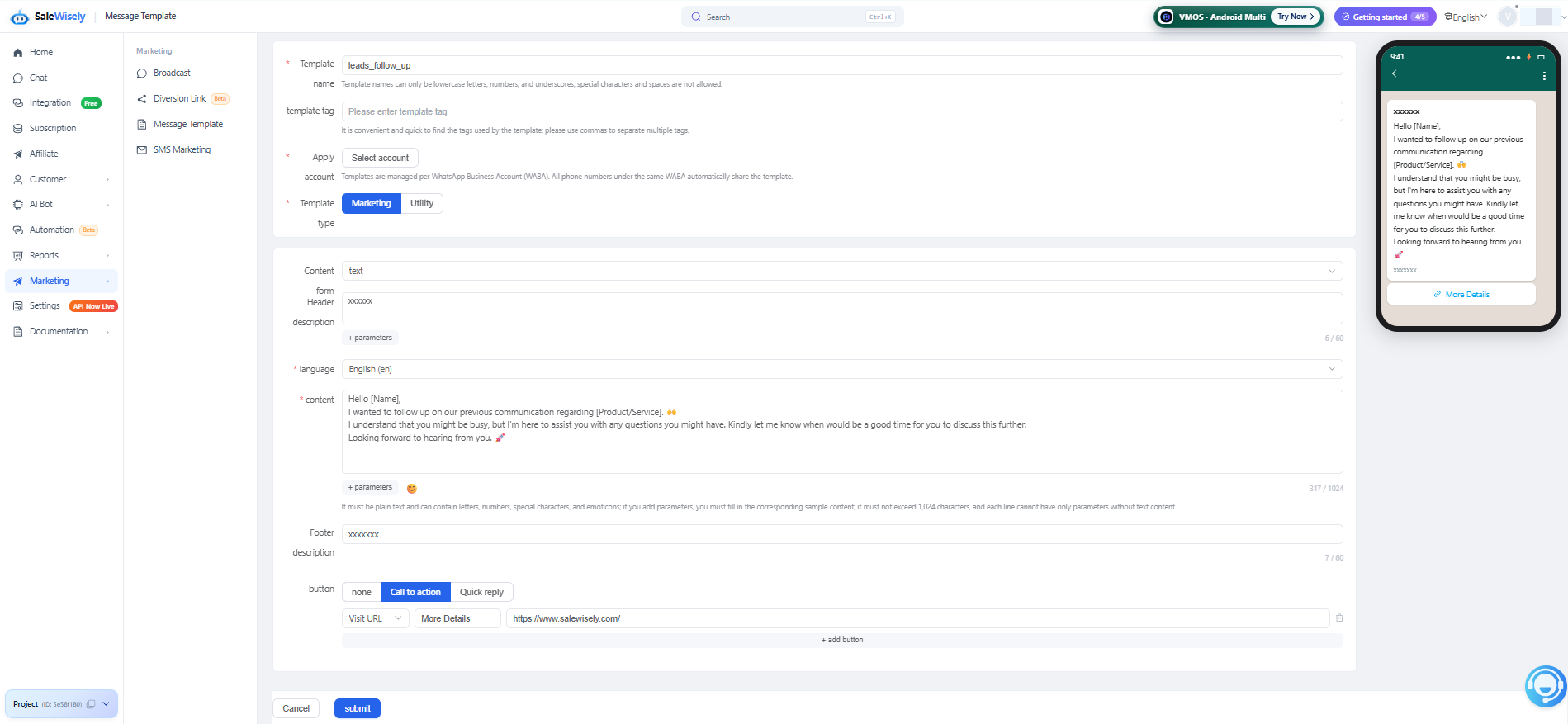
(Example template from SaleWisely)
Quote follow-up: for customers who received a price list but have not made a decision.
Example:
Hi {{name}}, we wanted to follow up on the quotation we shared for {{Product/Service Name}}. Do you have any questions or need any additional information before making a decision? We would be happy to help you find the option that best fits your needs.
Customer re-engagement: for inactive customers who may still be interested in the product.
Example:
Hi {{name}}, we have some updates that may be helpful based on your previous interest. Would you like to learn more?
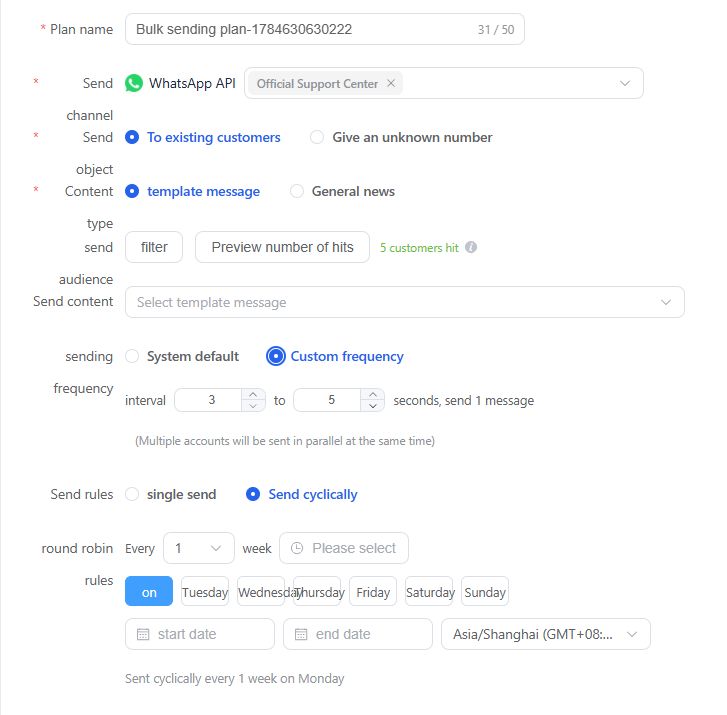
In addition, WhatsApp broadcast makes it possible to deliver bulk messages to specific customer groups. Businesses can use it for product launches, seasonal promotions, special offers, customer updates, re-engagement campaigns etc. SaleWisely supports businesses to send broadcast messages using general news or template messages and customize the execution time for better reach and engagement rate while reducing manual workload.
3. Automate follow-ups based on customer actions
An effective WhatsApp follow-up workflow is not only about sending messages, but also how to interact with customers at optimal time. Businesses can use drag-and-drop workflow builder to automate follow-up based on customer actions, including keyword replies, conversation status changes, or response timeouts. These triggers can automatically perform actions such as tagging customers, sending notifications, updating conversation status, or closing tickets.
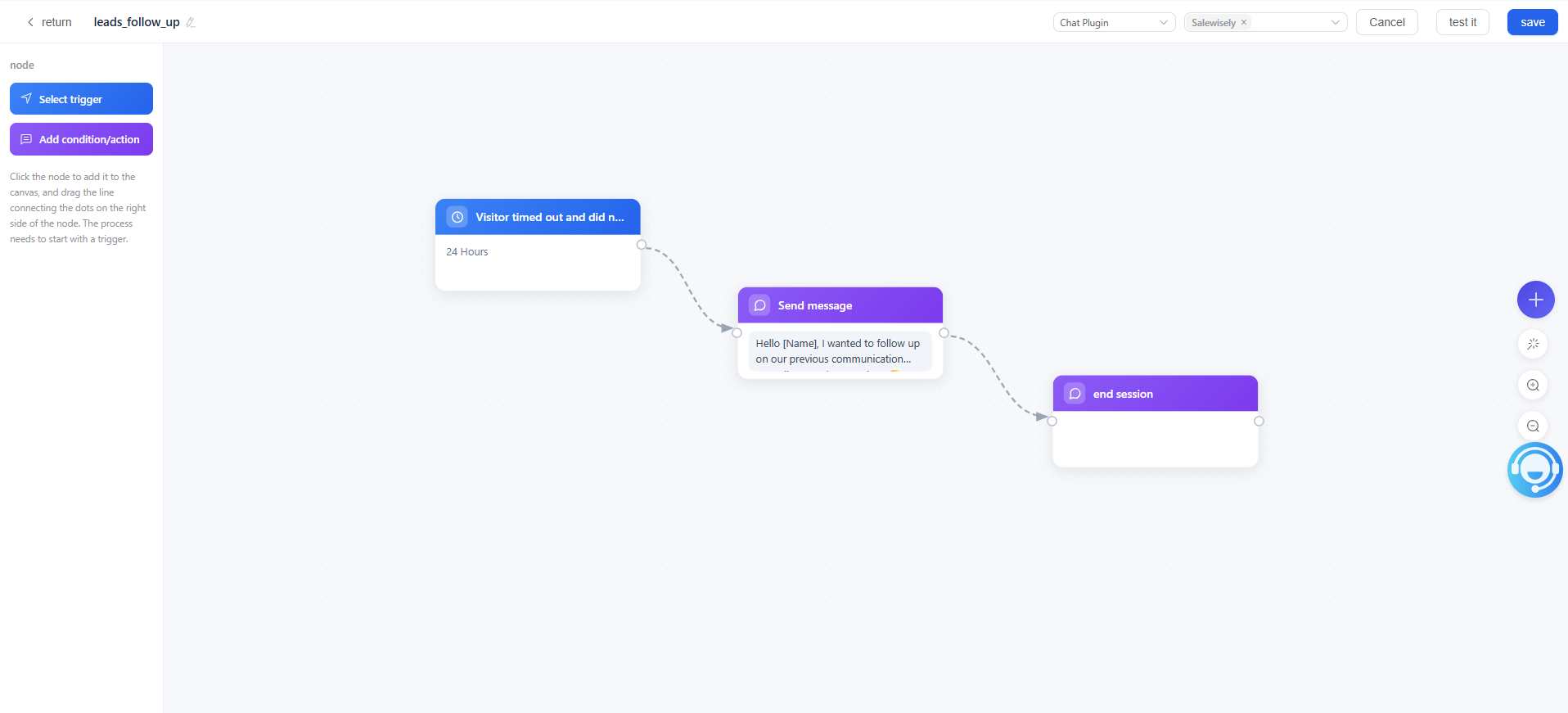
Business can also provide AI with product information, relevant documents, and previous conversation history, AI bot further improves the follow-up experience by helping businesses handle customer conversations more efficiently.
By combining automation workflows with AI bot, SaleWisely helps businesses reduce repetitive tasks, respond faster, and create a smarter WhatsApp follow-up process that turns more customer conversations into conversions.
FAQs
Why is WhatsApp effective for customer follow-up?
WhatsApp enables businesses to communicate with customers through a fast and familiar messaging channel. It supports real-time conversations, personalized communication, and automated follow-up workflows.
How do you politely follow-up on WhatsApp?
A polite WhatsApp follow-up should be short, helpful, and personalized.
Can WhatsApp follow-up messages be personalized?
Yes. Businesses can sort out customer information, conversation history, and create personalized message templates for different scenarios to follow up leads
How can businesses automate WhatsApp follow-up?
Businesses can automate WhatsApp follow-ups by workflows that trigger messages based on customer actions, such as inquiries, keyword replies, or inactive conversations. Automation helps businesses send timely follow-ups without manual tracking.