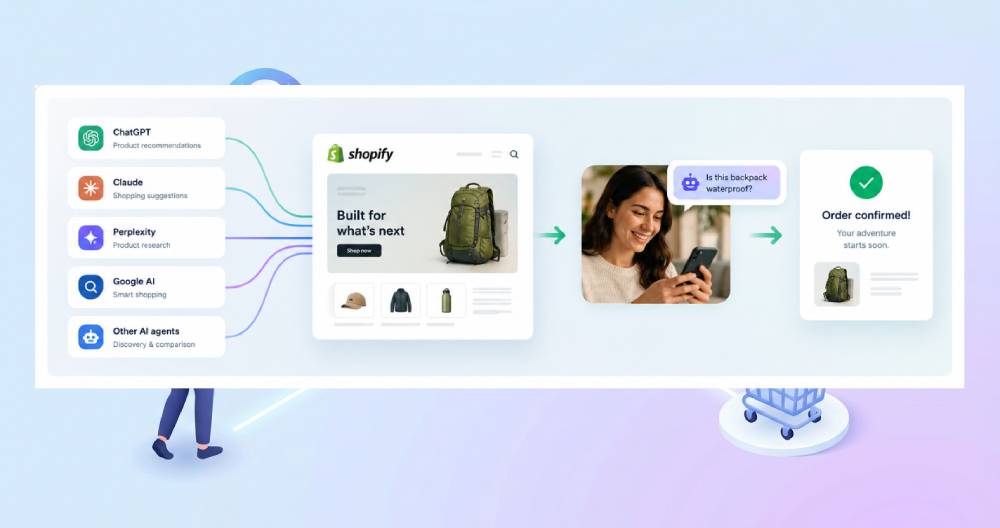
Shopify is making it easier for AI agents to discover products and help shoppers buy.
The company has been building new tools and standards around AI-powered commerce, including Agentic Storefronts and the Universal Commerce Protocol (UCP). Shopify is also working to make its merchants’ products available across new AI-powered shopping experiences.
For merchants, this raises a bigger question:
When an AI agent sends a shopper to your store, are you ready to convert them?
The shift is bigger than another traffic source.
People are starting to discover products through AI tools, not just Google, social feeds, or marketplace search. AI can help shoppers find products, compare options, and make buying decisions.
But getting discovered is only the first step.
The store still needs to answer questions, build trust, and turn that interest into a sale.
The New Reality for Shopify Merchants
AI agents do not shop exactly like people do.
They can look at product information, compare options, check details, and help shoppers decide what to buy.
But once a shopper reaches your store, the basic needs have not changed.
They still want clear product information. They want accurate shipping and return details. They may have questions about size, compatibility, or delivery.
Many stores are not ready for this new buying journey.
Common problems include:
l Product information that looks good to shoppers but is incomplete or inconsistent.
l Support teams handling the same questions across WhatsApp, Instagram, email, and live chat.
l Language barriers that slow down international sales.
l No easy way to continue a conversation after a shopper leaves the store.
l Customer information spread across different tools and channels.
This creates a new gap:
AI can bring more product discovery, but merchants still need to turn that discovery into conversations and sales.
What Does It Mean to Be Ready for AI Agents?
You do not need to build a complex AI system to prepare for AI commerce.
For most Shopify stores, three things matter most:
1. Make your product and store information clear and accurate.
2. Help shoppers when they have questions.
3. Keep the conversation connected when shoppers move between channels.
Think about a simple journey:
AI recommendation → Shopify store → product question → WhatsApp → purchase
AI may start the journey.
But the merchant still has to close it.
That makes customer service, sales, and automation part of the AI commerce experience.
What Actually Works Right Now
1. Make Your Store Agent-Friendly
Clean product data, accurate inventory, and clear store policies are becoming more important as AI systems interact with Shopify Catalog.
But product data is only the start.
A shopper may still ask:
l Which size should I choose?
l Does this product work with another product?
l How long will shipping take to my country?
l Can I return it?
l Which option is better for me?
A static FAQ cannot always answer these questions in the right context.
An AI shopping assistant can help shoppers get answers while they are still deciding whether to buy.
The goal is not to add AI just because you can.
The goal is to remove the questions that stop people from buying.
2. Treat Every Conversation as a Sales Opportunity
Support and sales are becoming more connected.
A shopper may start by asking about a product. Then they may ask about shipping. After that, they may decide whether to buy.
That means a support conversation can also be a sales opportunity.
AI can handle common questions, provide product information, qualify leads, and take care of other repetitive tasks.
When a conversation needs human judgment, it can be handed to a team member.
This is especially useful for cross-border ecommerce businesses.
Customers may contact you at different times, through different channels, and in different languages. A connected system makes these conversations easier to manage.
3. Close the Loop Across Channels
AI discovery may happen outside your Shopify store.
A shopper might discover a product through an AI tool, visit your store, and then contact you on WhatsApp or Instagram.
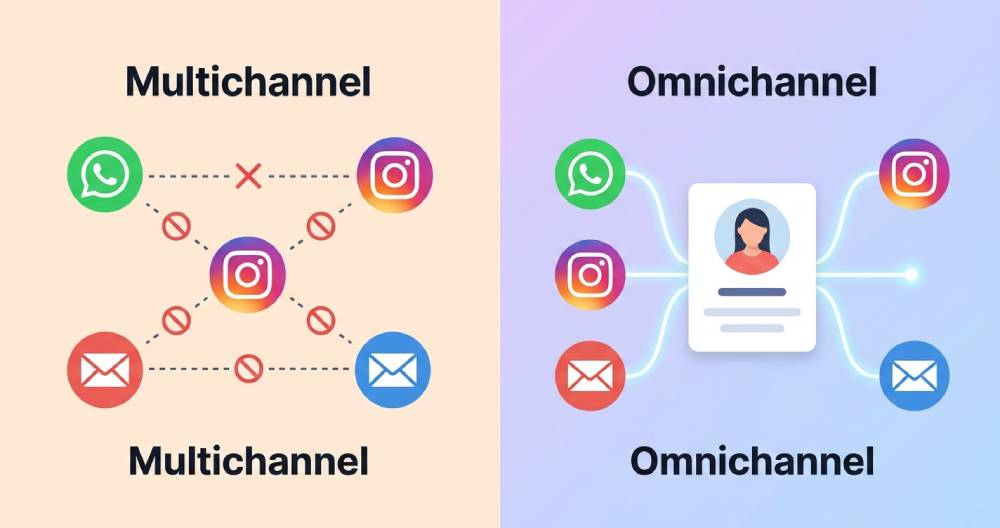
The shopper sees one buying journey.
Your business may see three separate conversations.
That is a problem.
Without shared customer information and conversation history, shoppers may have to repeat themselves. Your sales team may also lose important context.
A better setup connects the channels and keeps the conversation moving.
Where an Omnichannel AI Platform Fits
These three practices give merchants a practical starting point.
The next challenge is connecting them.
You need to help shoppers on your website, keep their context when they move to messaging apps, and automate routine questions without losing the human touch.
That is where an omnichannel AI platform can help.
On-Site AI Shopping Guide
SaleWisely's On-Site AI Shopping Guide can be added to a Shopify store with one line of code.
It gives shoppers real-time help while they browse. They can ask product questions and get help with common purchase decisions.
For example, an AI shopping assistant can help with product information, recommendations, shipping questions, and other issues that may stop someone from buying.
The idea is simple:
Help the shopper at the moment they are deciding whether to buy.
Instead of making customers search through product pages and FAQs, an AI assistant can help them find the information they need through a conversation.
AI Agent Across Customer Channels
The same approach can extend beyond the website.
SaleWisely brings conversations from channels such as WhatsApp, LINE, Telegram, Instagram, Messenger, email, and web chat into one shared workspace.
Its AI Agent can answer routine questions, use information from a knowledge base, and assist with customer requests. When a conversation needs human attention, agents can step in.
For international businesses, real-time translation can also help teams communicate with customers across languages.
The value is not just one AI feature.
It is the connection between:
AI discovery → customer conversation → sales follow-up
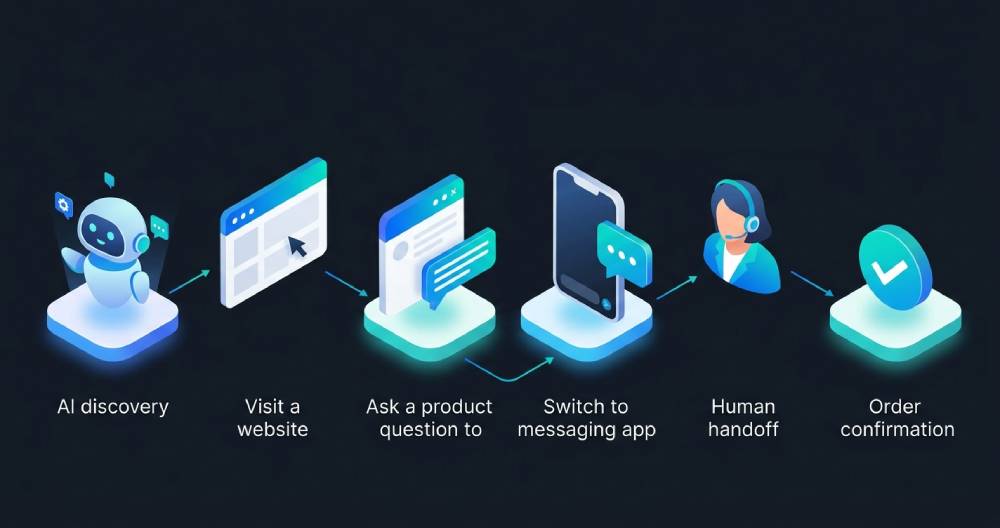
A Simple Shopify AI Commerce Workflow
Here is what that journey can look like:
Step 1: AI Discovery
A shopper discovers your product through an AI-powered experience.
Step 2: Store Visit
The shopper visits your Shopify store to learn more.
Step 3: Product Question
They have a question about size, compatibility, shipping, or another purchase concern.
Step 4: AI Assistance
An AI shopping assistant provides an answer while the shopper is still on the site.
Step 5: Channel Switch
The shopper moves to WhatsApp or another messaging channel.
Step 6: Continued Context
The business can continue the conversation without treating the shopper like a completely new customer.
Step 7: Human Handoff
If the question is more complex, a human agent can take over.
Step 8: Purchase
The shopper gets the information they need and completes the purchase.
This is the part merchants should pay attention to.
AI may start the customer journey. The conversation still has to lead to a sale.
Practical Next Steps for Shopify Merchants
You do not need to rebuild your entire tech stack to prepare for AI commerce.
Start with the areas that can have the biggest impact.
Audit Your Product Information
Review your product descriptions, variants, pricing, inventory, shipping policies, and return policies.
Make sure the information is accurate and consistent.
This helps both shoppers and AI systems understand what you sell.
Find the Questions That Block Purchases
Look through your customer conversations.
What do shoppers ask before they buy?
Which questions come up again and again?
These are good candidates for AI or automation.
Connect Your Main Customer Channels
If customers contact you through WhatsApp, Instagram, email, website chat, or other messaging platforms, consider bringing those conversations into one workspace.
You do not need every channel.
Start with the channels your customers actually use.
Add AI Where It Solves a Real Problem
AI works best when it removes repetitive work or helps shoppers make decisions faster.
An on-site AI assistant can help shoppers find answers.
An AI customer service agent can handle routine questions.
Human agents can focus on conversations that need judgment, product knowledge, or personal attention.
Measure More Than AI Traffic
AI-driven discovery is interesting, but traffic alone does not tell you if the strategy is working.
Track metrics such as:
l Conversion rate
l Average order value
l Customer questions before purchase
l Response time
l Resolution time
l Repeat contacts
l Sales influenced by customer conversations
The goal is not simply to get more AI traffic.
The goal is to turn AI-driven discovery into revenue.
Shopify Is Building the Rails. Merchants Still Have to Close the Loop.
Shopify is building the infrastructure for a new kind of shopping experience.
AI can help shoppers discover products. It can help them compare options. It can even become part of the buying process.
But merchants still control what happens after that first interaction.
A shopper may still have questions.
They may switch from your website to WhatsApp.
They may need a human.
And they still need a reason to complete the purchase.
That is why the next stage of ecommerce is not just about AI traffic.
It is about connecting:
AI discovery → conversation → conversion
SaleWisely is built around this connection. It combines AI-powered customer conversations, omnichannel messaging, automation, and customer management in one platform.
The stores that treat AI traffic as just another acquisition channel will compete on volume.
The ones that close the conversation-to-order loop will compete on results.
And that may be the real advantage in the next stage of AI commerce.