Instagram is no longer just a place to post Reels, share Stories, or grow your follower count. For many brands, it has become a genuine sales channel.
A customer sees your Reel, replies to your Story, comments on a product post, or sends you a DM with a simple question like, “How much does this cost?” From there, the conversation can go one of two ways: it leads to a sale, or it goes nowhere.
So how do you sell products through Instagram DMs without coming across as pushy or overly promotional?
The answer isn’t sending more messages. It’s having better conversations.
A strong Instagram DM sales strategy is about understanding what customers need, answering their questions, recommending the right product or service, and making it easy for them to take the next step.
In this guide, we’ll walk you through how to sell through Instagram DMs, including what to say, how to follow up, and how to use automation, AI, shared inboxes, and CRM tools to scale your sales while keeping conversations natural and personal.
Why Instagram DMs Matter for Sales
Your Instagram content gets people’s attention. Your DMs turn that attention into action.
Unlike a product page, DMs give you a chance to have a real one-on-one conversation with a potential customer. You can answer specific questions, understand what they need, recommend the right solution, and address concerns before they buy.
This becomes especially valuable when someone isn’t quite ready to make a purchase yet.
Imagine a potential customer sends you a message:
“Is this product a good fit for a small business?”
A typical response would be to answer the question and send them a link to your pricing page.
A better approach might be:
“Absolutely. How are you currently managing customer conversations?”
That question helps you better understand what the person actually needs.
And that’s the core of effective DM selling: Don’t rush into the pitch. Start the conversation, understand the customer’s needs, and then connect your product to those needs naturally.
The Instagram DM Sales Funnel
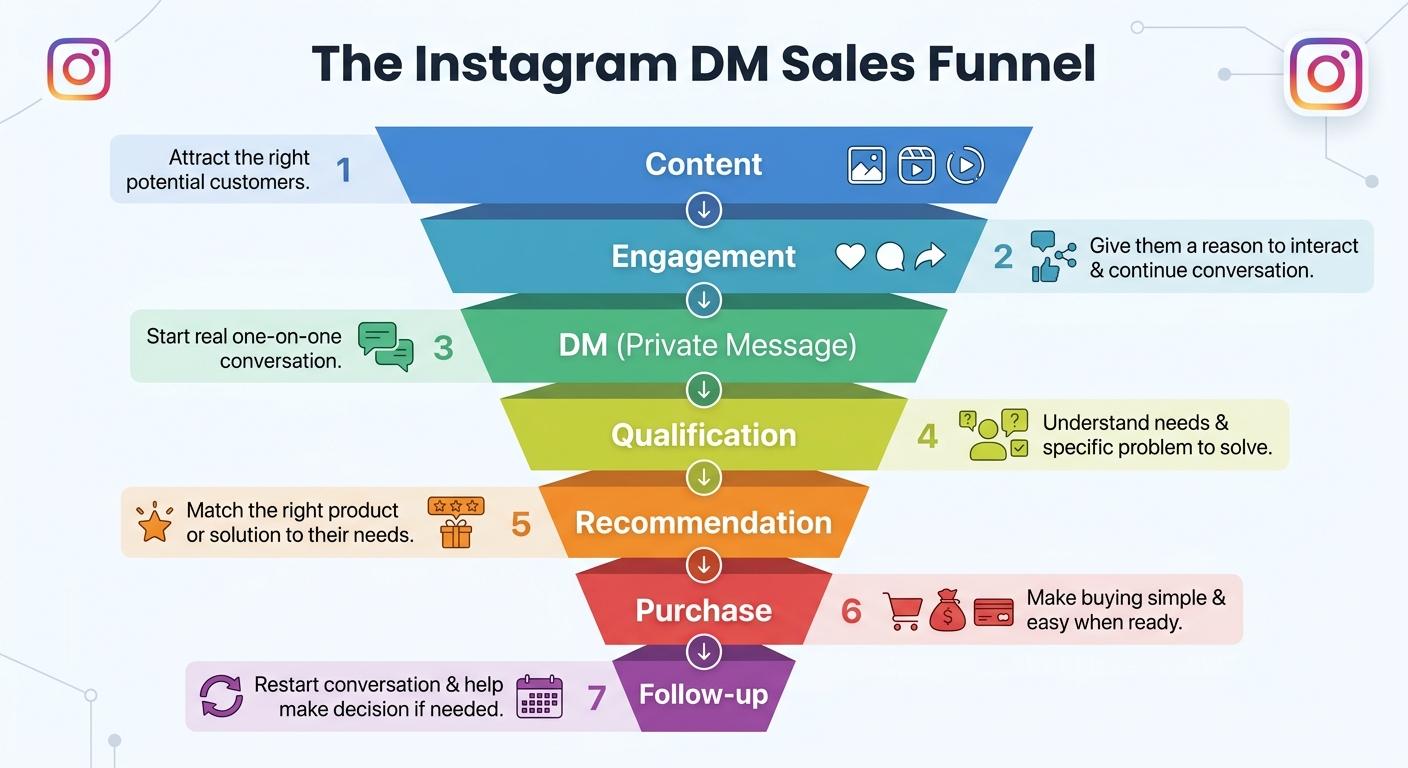
A simple Instagram DM sales process looks like this:
Content → Engagement → DM → Qualification → Recommendation → Purchase → Follow-up
Each stage serves a specific purpose:
| Stage | Purpose |
| Content | Attract the right potential customers |
| Engagement | Give them a reason to interact and continue the conversation |
| DMs | tart the real one-on-one conversation |
| Qualification | Understand what they need and what problem they’re trying to solve |
| Recommendation | Match them with the right product or solution |
| Purchase | Make the buying process as simple as possible |
| Follow-up | Re-engage prospects who don’t buy right away |
The goal isn’t to get everyone to buy. It’s to make it easier for the right customers to make a purchase decision.
Step 1: Give People a Reason to DM You
Before worrying about what to say in a DM, think about why someone would message you in the first place. The best DM conversations usually start with a clear reason to reach out.
Use Comment-to-DM CTAs
A simple call to action can turn public engagement into a private conversation.
l “Comment ‘LINK’ and I’ll DM you the details.”
l “Comment ‘GUIDE’ and I’ll send you the checklist.”
The key is to give people something valuable in return. Don’t ask people to comment just to boost engagement. Give them a clear next step that directly connects to what they’re interested in.
For example:
l “Want the full product comparison? Comment ‘COMPARE’ and I’ll send it to you.”
Use Instagram Stories
Stories are another great way to start conversations. You can use polls, question stickers, sliders, and other interactive features to learn more about what your audience cares about.
For example:
“What’s your biggest challenge with selling on Instagram?”
1. Getting more leads
2. Turning DMs into sales
3. Following up with leads
When someone selects “Turning DMs into sales,” you’ve already learned something useful about them.
From there, you can create a follow-up Story that answers the question publicly, or continue the conversation privately through DMs.
Pay Attention to Product Questions
Not every DM is a sales lead, but some messages are clear buying signals:
l “How much is this?”
l “Do you ship to Canada?”
l “Is this still available?”
l “Do you have this model?”
l “Does this work with Shopify?”
Step 2: Don’t Jump Into the Pitch
This is one of the most common mistakes businesses make when selling through Instagram DMs.
A customer may simply ask a quick question, and you respond with a long product description and a full sales pitch.
| Avoid this: Salesy | Try this: Conversational |
| “Thanks for reaching out! Our product is the perfect solution for businesses and includes X, Y, and Z features. Sign up today!” | “It’s $49. We have a few options depending on what you need. Which one are you leaning toward?” |
| “Yes, we support both Instagram and WhatsApp. Are you mainly looking for help with sales, customer support, or both?” |
The difference is simple: one sounds like a pitch, while the other sounds like a conversation.
Answer the customer’s question first, then use a natural follow-up question to keep the conversation moving.
Don’t be afraid to ask a simple follow-up question. You can also ask for permission before making a recommendation, which makes the conversation feel more natural:
“Would you like me to show you how it works?”
Or:
“Would it help if I sent you the option that best fits your setup?”
Step 3: Ask the Right Questions
You don’t need a long explanation, and you definitely don’t need to fire off ten qualification questions like you’re filling out a form.
When selling through Instagram DMs, less is often more.
Ask one useful question, listen to the answer, and use that answer to naturally guide the next part of the conversation.
The right question depends on what you’re selling:
| Business Type | Example Qualification Question |
| E-commerce | “What size do you usually wear?” / “Is this for everyday wear or a specific occasion?” |
| Services | “What are you hoping to improve most right now?” |
| SaaS | “How are you currently managing customer messages?” / “What’s the biggest challenge with your current setup?” |
| Digital products | “Are you looking for something beginner-friendly or more advanced?” |
Ask One Question at a Time
Don’t send all of these questions at once:
“What’s your budget? How many people are on your team? What software are you using? How many employees do you have? What are your monthly sales? What’s your biggest challenge? What are your goals? When are you planning to get started?”
That can quickly make the conversation feel like a survey instead of a real conversation.
A more natural approach would be:
“How are you currently handling these messages?”
Start by understanding the current situation, then use the customer’s answer to decide what to ask next.
Good DM selling isn’t about asking every question upfront. It’s about making each question build naturally on the previous answer and moving the conversation forward one step at a time.
Step 4: Show Them You Understand Their Needs
Once the customer explains what they need, make sure they know you understood them.
For example:
“It sounds like your biggest challenge is keeping up with all your messages in real time, right?”
This does two things:
l First, it shows that you actually understand the customer’s problem.
l Second, it gives them a chance to clarify or correct you before you make a recommendation.
Step 5: Recommend the Right Solution
Once you understand the customer’s needs, don’t overwhelm them with every feature your product offers. Giving people too much information too early is one of the fastest ways to lose their attention.
Instead, use a simple formula to connect the problem to the solution:
Customer problem → Relevant feature → Real-world benefit
For example:
“Since your team is currently managing Instagram and WhatsApp separately, a shared inbox could be a great place to start. Your team can manage all incoming conversations from one place without switching back and forth between different apps.”
The recommendation feels relevant because it directly addresses the customer’s situation.
Step 6: Handle Objections Without Pushing
Not every objection means the customer is saying no.
Sometimes “It’s too expensive” simply means they’re not sure whether it’s worth the investment, or they’re comparing you with other options.
| Customer Objection | Suggested Response |
| “It’s too expensive.” | “I completely understand. Are you mainly comparing it with other options, or are you still deciding whether the investment is worth it?” |
| “I need to think about it.” | “Of course. Is there anything in particular you’re still unsure about?” |
| “I’m not sure this is right for me.” | “What would you ideally like it to help you solve?” |
The goal isn’t to overcome every objection. It’s to understand what’s behind it.
Step 7: Make the Purchase Easy
Once a customer is ready to buy, don’t make them work through a complicated process.
Give them a clear next step:
| Business Type | Example Closing Message |
| E-commerce | “Here’s the direct link to the black version: [Link]” |
| SaaS | “Based on what you mentioned, I’d recommend starting with the free plan. Here’s the signup link: [Link]” |
| Services | “That sounds like a great fit. Here’s the link to book a call: [Link]” |
The easier the next step is, the less likely you are to lose the sale to unnecessary friction.
Step 8: Follow Up Without Being Annoying
Good follow-up adds value. It doesn’t create pressure.
| Follow-up Type | Example |
| Weak follow-up | “Hey, just checking in.” → “Did you see my message?” → “Any updates?” |
| Value-driven follow-up | “I wanted to share one more thing that might help. You mentioned response time was one of your biggest challenges, and this workflow could help with that.” |
| Low-pressure follow-up | “You mentioned that you’re comparing a few options. I’m happy to answer any questions if that would be helpful.” |
The best follow-ups give the customer a reason to respond.
Instagram DM Sales Scripts You Can Use Right Away
| Situation | DM Script |
| Someone asks about the price | “It’s $49. We have a few different options depending on what you need. Which one are you most interested in?” |
| Someone asks for the link | “Absolutely! Here’s the direct link: [Link]. Which version are you looking for?” |
| Someone comments “LINK” | “Hey! Thanks for your interest 😊 Are you looking for Option A or Option B?” |
| Someone asks about your product | “Absolutely. What are you mainly looking to solve?” |
| SaaS prospect | “Happy to help. How are you currently managing your Instagram conversations?” |
| Someone is ready to buy | “Awesome! Here’s the direct purchase link: [Link]. Let me know if you have any questions before you get started.” |
How to Scale Instagram DM Sales With Automation
The goal of automation isn’t to automate every conversation. It’s to automate the parts that don’t require human involvement.
| Automation Task | What It Does |
| Automate Common Questions | Instantly answer questions about pricing, shipping, and basic product details |
| Automatically Qualify Leads | Collect customer information and identify buying intent |
| Automatically Route Leads | Assign conversations to the right team member |
| Automatically Follow Up With Leads | Re-engage prospects who showed buying intent but haven’t purchased |
How to Scale Instagram DM Sales With SaleWisely
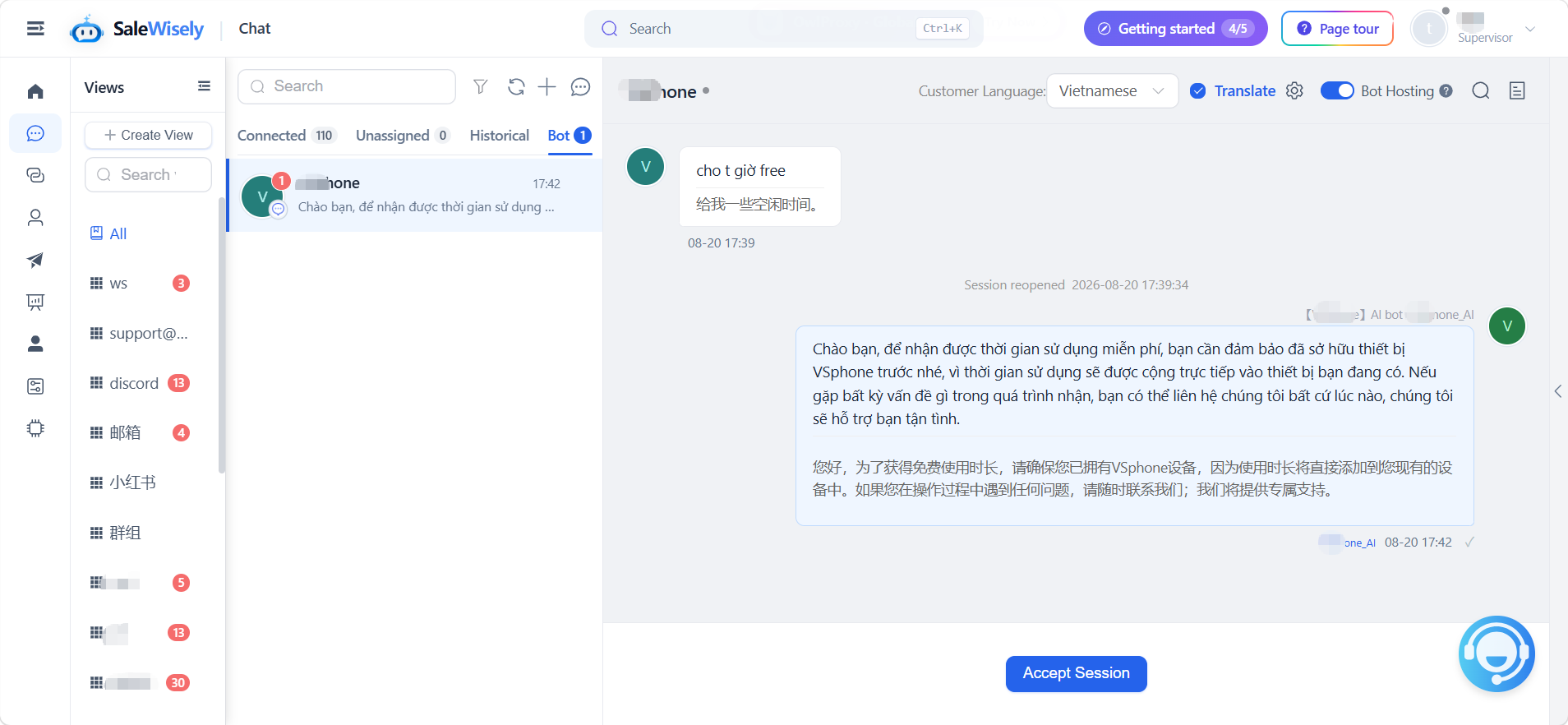
SaleWisely doesn’t treat Instagram as a standalone inbox. Instead, it brings Instagram, WhatsApp, Facebook, TikTok, and other customer communication channels together in one workspace.
Shared Inbox
Teams can manage customer conversations from multiple platforms in one shared inbox and always see where each conversation stands.
AI Sales Assistance
Automatically handle repetitive questions, help generate replies, and support real-time multilingual conversations.
CRM Integration
Connect Instagram conversations directly to customer profiles so sales teams can see the full conversation history and context at any time.
8 Common Instagram DM Sales Mistakes
1. Pitching too early: Starting with a sales pitch instead of first understanding why the person contacted you.
2. Sending a link too soon: Sharing a URL before figuring out which product or option is actually right for the customer.
3. Listing every feature: Dumping an entire product catalog or technical specification sheet into the conversation.
4. Asking too many questions: Firing off questions one after another instead of keeping the conversation natural.
5. Sounding like a bot: Relying too heavily on scripts without adding any personal or contextual touches.
6. Creating fake urgency: Claiming that an offer “ends tonight” when it doesn’t.
7. Following up too often: Sending multiple messages without providing anything new or useful.
8. Treating every follower like a buyer: Ignoring the difference between casual engagement and genuine buying intent.
Instagram DM Sales Strategies by Business Type
| Business Type | Instagram DM Sales Flow |
| E-commerce | Product → Fit → Style → Price → Checkout |
| Services | Need → Goal → Qualification → Recommendation → Call / Close |
| SaaS | Current process → Pain point → Use case → Fit → Demo / Signup |
| Creators & digital products | Content → Interest → Conversation → Solution → Checkout |
Final Takeaway: Help Instead of Hard-Sell
The best conversations happen when customers feel understood.
Keep your Instagram DM strategy simple:
Trigger → Open → Qualify → Recommend → Reassure → Convert → Follow Up
Your content creates interest. Your DMs build the relationship. And a platform like SaleWisely helps you manage the entire process at scale.
When every conversation is centered on helping the customer, sales become a natural outcome rather than something you have to force.