Last updated: September 2026
Freshdesk is one of the closest direct competitors to Zendesk for traditional help desk software. However, there is no single biggest competitor across every customer service category.
Salesforce competes more directly with Zendesk in enterprise CRM and service operations, Intercom focuses on conversational and AI-powered support, Gorgias is strongly focused on ecommerce, and SaleWisely focuses on social and messaging customer service.
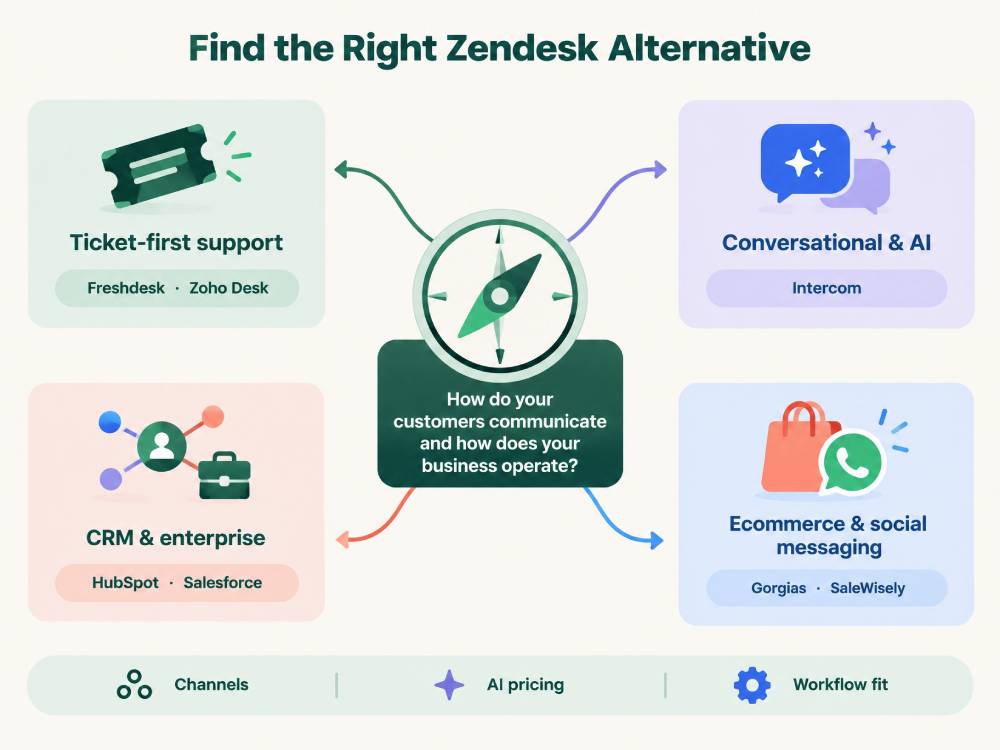
The right Zendesk alternative depends on how your team handles customer conversations, which channels you use, how much automation you need, and how your support operation is structured.
Quick Answer
Freshdesk is one of the closest Zendesk alternatives for traditional help desk software, while other competitors become more relevant depending on the customer service model.
For example:
1. Freshdesk — traditional help desk and ticketing
2. Intercom — conversational and AI-powered customer support
3. HubSpot — CRM-connected customer service
4. Salesforce — enterprise CRM and service operations
5. Gorgias — ecommerce customer support
6. Front — shared inbox and collaborative customer communication
7. Help Scout — straightforward customer support
8. Zoho Desk — help desk within the Zoho ecosystem
9. Pylon — B2B customer communication and support
10. SaleWisely — social and messaging-based customer service
There is also evidence that the market is broader than a simple Zendesk-versus-one-competitor comparison. According to G2’s 2026 Help Desk category, the category includes products such as Zendesk for Customer Service, Salesforce Service Cloud, Zoho Desk, Freshdesk, HubSpot Service Hub, and Intercom.
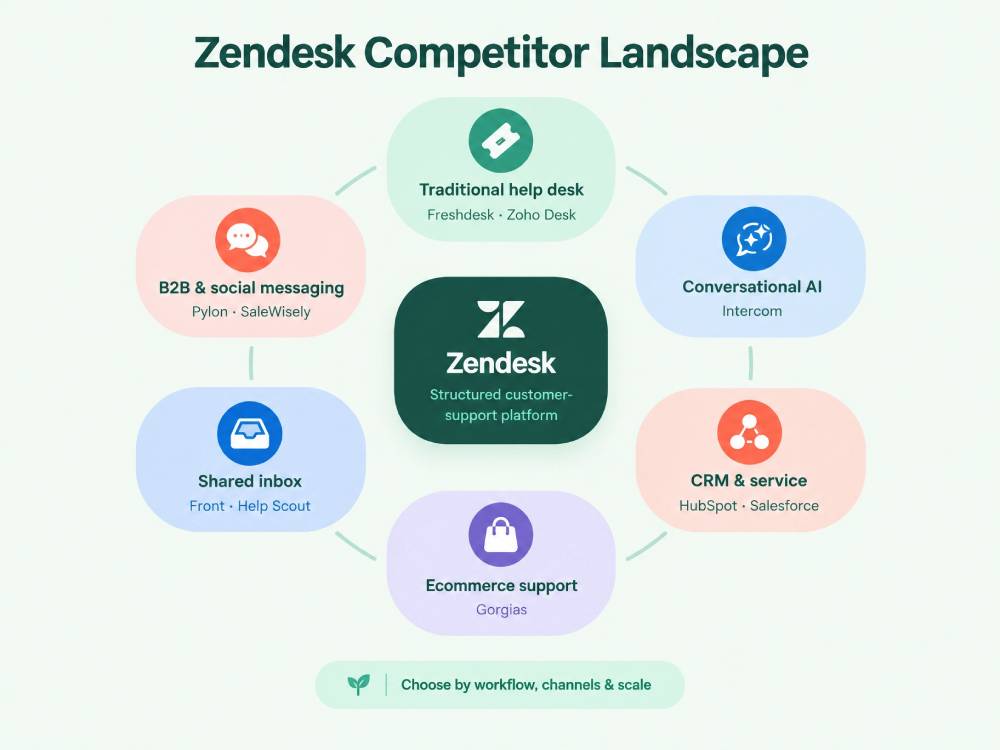
Zendesk Competitor Landscape
Zendesk is primarily known as a customer service and help desk platform, but its competitive landscape now spans several different categories.
Platform | Competitive Category | Typical Team | Pricing Approach | Key Differentiator |
Freshdesk | Traditional help desk | SMB → Mid-market | Per-agent | Ticket-based customer support |
Intercom | Conversational / AI | SaaS → Enterprise | Seat + usage | AI-first conversational support |
HubSpot | CRM + Service | SMB → Enterprise | Hub / seat-based | CRM-connected customer service |
Salesforce | Enterprise CRM + Service | Mid-market → Enterprise | Subscription + usage | Enterprise CRM ecosystem |
Gorgias | Ecommerce support | SMB → Mid-market | Usage / ticket-based | Ecommerce workflows |
Front | Shared inbox | SMB → Mid-market | Per-seat | Collaborative customer communication |
Help Scout | Customer support | SMB → Mid-market | User-based | Simple support workflows |
Zoho Desk | Traditional help desk | SMB → Enterprise | Per-user | Help desk within Zoho ecosystem |
Pylon | B2B support | B2B / SaaS teams | Plan and usage dependent | B2B communication workflows |
SaleWisely | Social + messaging | SMB → Enterprise | Free + optional AI credits | Social and messaging conversations |
The important point is that these products do not all compete with Zendesk in exactly the same way.
A company looking for a traditional ticketing system may compare Zendesk with Freshdesk or Zoho Desk. A SaaS company focused on conversational support may look at Intercom. An ecommerce business may compare Gorgias. A company already built around Salesforce or HubSpot may prefer to keep customer service inside its CRM.
Why Are Businesses Looking for Zendesk Alternatives?
Businesses typically evaluate Zendesk alternatives for a few recurring reasons.
1. Pricing and scalability
Customer service software can become more expensive as teams add agents, channels, automation, AI usage, or other capabilities.
Zendesk's current customer service pricing includes Support Team at $19 per agent per month when billed annually, with higher-priced Suite plans adding broader capabilities. (Zendesk pricing)
That makes the pricing model an important part of any comparison. Businesses should look at the expected total cost rather than comparing only the lowest advertised starting price.
2. Platform complexity
Zendesk can support sophisticated support operations, but some smaller teams may not need every feature available in a larger customer service platform.
For those teams, simpler tools such as Help Scout, Front, or Freshdesk may be considered when ease of administration is more important than extensive customization.
3. The shift toward AI-assisted support
Customer service platforms now offer AI agents, automated workflows, knowledge bases, and AI-assisted agent tools.
For example, Intercom's current plans combine seat-based pricing with usage-based charges for Fin AI Agent outcomes and certain communication channels. Its annual plans currently start at $29 per seat for Essential, followed by $85 for Advanced and $132 for Expert. Fin AI Agent starts at $0.99 per outcome. (Intercom pricing)
This means businesses now need to compare not only human agent features but also how AI is priced and where AI fits into the support workflow.
4. More customer conversations happen outside email
Traditional help desks were largely designed around tickets, email, and structured support queues.
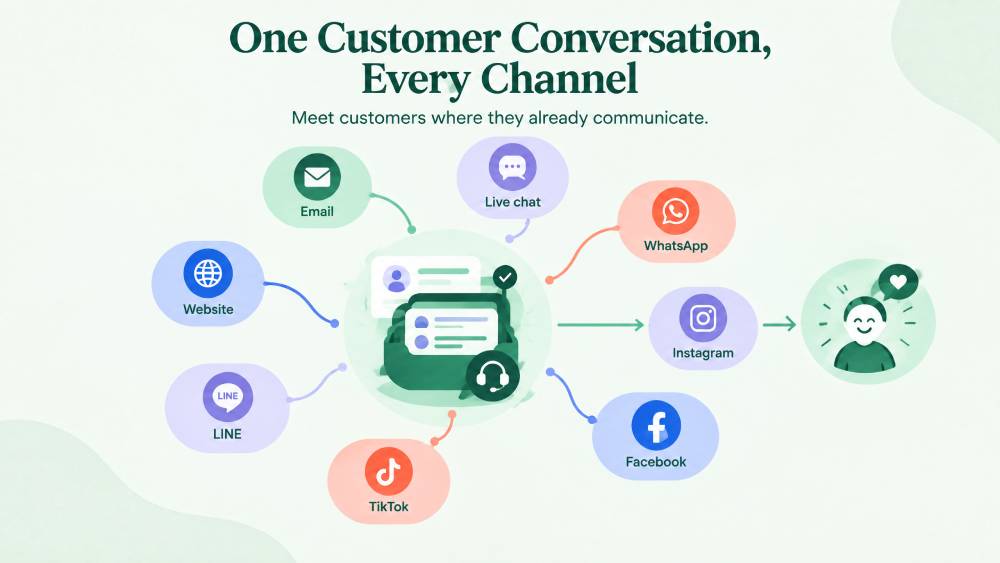
Many businesses now receive customer messages through WhatsApp, Instagram, Facebook, TikTok, LINE, live chat, and other messaging channels.
For these businesses, the question is not simply:
Which help desk has the most features?
It is also:
Which platform fits the channels where our customers actually contact us?
The 10 Main Zendesk Competitors
1. Freshdesk
Freshdesk is one of the most direct alternatives to Zendesk for traditional help desk operations.
Freshdesk focuses on ticket management, customer support workflows, automation, knowledge management, and omnichannel support.
It is particularly relevant for companies that want a conventional help desk rather than a platform built primarily around conversational messaging.
Best suited to:
l Traditional customer support teams
l SMB and mid-market companies
l Email and ticket-based support
l Teams that need automation and structured workflows
Compared with Zendesk: Freshdesk is often evaluated as a direct help desk alternative because the two products address similar support workflows.
2. Intercom
Intercom takes a more conversational approach to customer service.
Its current platform combines a shared inbox, messaging, ticketing, automation, help center capabilities, and Fin AI Agent.
Intercom's current annual pricing starts at $29 per seat per month for Essential, followed by $85 for Advanced and $132 for Expert. Fin AI Agent is charged according to outcomes, starting at $0.99 per outcome. (Intercom pricing)
Best suited to:
l SaaS companies
l Conversational customer support
l Product-led businesses
l Teams investing heavily in AI support
Compared with Zendesk: Intercom is particularly relevant when a business wants customer conversations, product engagement, and AI-assisted support to work together.
3. HubSpot Service Hub
HubSpot Service Hub connects customer service with HubSpot's broader CRM platform.
Its service tools include ticketing, team email, live chat, knowledge base, automation, and customer information connected to the CRM.
Best suited to:
l Businesses already using HubSpot CRM
l Sales and service teams that need shared customer context
l SMB and growing businesses
l Teams looking for CRM and service integration
Compared with Zendesk: HubSpot becomes especially relevant when customer service is closely connected to marketing and sales activities.
4. Salesforce Service Cloud
Salesforce Service Cloud competes with Zendesk primarily in larger and more complex customer service environments.
Salesforce combines customer service with its broader CRM ecosystem, including case management, self-service, automation, analytics, and AI capabilities.
Best suited to:
l Mid-market companies
l Enterprise organizations
l Complex service operations
l Businesses already using Salesforce
Compared with Zendesk: Salesforce is particularly relevant when customer service needs to operate as part of a larger enterprise CRM environment.
5. Gorgias
Gorgias is designed primarily for ecommerce businesses.
The platform connects customer support with ecommerce workflows and customer information, allowing support teams to handle questions related to orders, returns, products, and other shopping activities.
Best suited to:
l Shopify and ecommerce businesses
l Online retailers
l Customer service teams handling order-related questions
l Brands that want support connected to ecommerce operations
Compared with Zendesk: Gorgias is more specialized around ecommerce support rather than general-purpose customer service.
6. Front
Front approaches customer support from a shared-inbox and collaborative communication perspective.
Instead of treating every customer interaction primarily as a traditional ticket, Front combines shared communication, routing, automation, analytics, and customer context.
Best suited to:
l Shared inbox workflows
l Customer-facing operations teams
l Businesses managing email and multiple communication channels
l Teams that value collaboration
Compared with Zendesk: Front can be a fit for organizations that think of customer communication as a collaborative inbox rather than a conventional help desk queue.
7. Help Scout
Help Scout focuses on customer support without trying to provide the same level of enterprise complexity as some larger service platforms.
Its product includes shared inboxes, knowledge base tools, reporting, and customer communication features.
Best suited to:
l Small support teams
l Growing businesses
l Email-based support
l Teams that prefer straightforward workflows
Compared with Zendesk: Help Scout is often considered when a company wants customer support functionality without building a highly complex support operation.
8. Zoho Desk
Zoho Desk is another direct help desk alternative.
Zoho Desk provides ticket management, automation, knowledge base functionality, AI capabilities, and connections to other Zoho applications.
Best suited to:
l SMBs
l Companies already using Zoho products
l Traditional help desk operations
l Teams looking for a broader business software ecosystem
Compared with Zendesk: Zoho Desk can be particularly relevant when customer service needs to connect with the rest of the Zoho ecosystem.
9. Pylon
Pylon focuses on B2B customer communication and support.
Its approach is relevant to companies whose customers communicate through multiple channels and where support, account management, and customer relationships overlap.
Best suited to:
l B2B SaaS companies
l Customer success teams
l Account management workflows
l Businesses managing customer communication across multiple channels
Compared with Zendesk: Pylon is more specifically oriented toward B2B customer communication rather than serving as a general-purpose help desk for every type of support organization.
10. SaleWisely
SaleWisely focuses on social and messaging-based customer communication.
The platform brings multiple channels into one workspace, including WhatsApp, Instagram, TikTok, Facebook, LINE, Telegram, email, website chat, and other channels.
SaleWisely currently positions its core platform as free forever, with unlimited seats, channels, and cloud hosting, while optional AI capabilities use AI credits. (SaleWisely pricing)
Best suited to:
l Social-media-first businesses
l Businesses selling internationally
l Teams using WhatsApp and social messaging
l Companies managing customer conversations across multiple messaging channels
Compared with Zendesk: The main difference is the starting point. Zendesk is primarily a customer service platform built around structured support operations, while SaleWisely puts social and messaging conversations at the center of the customer communication workflow.
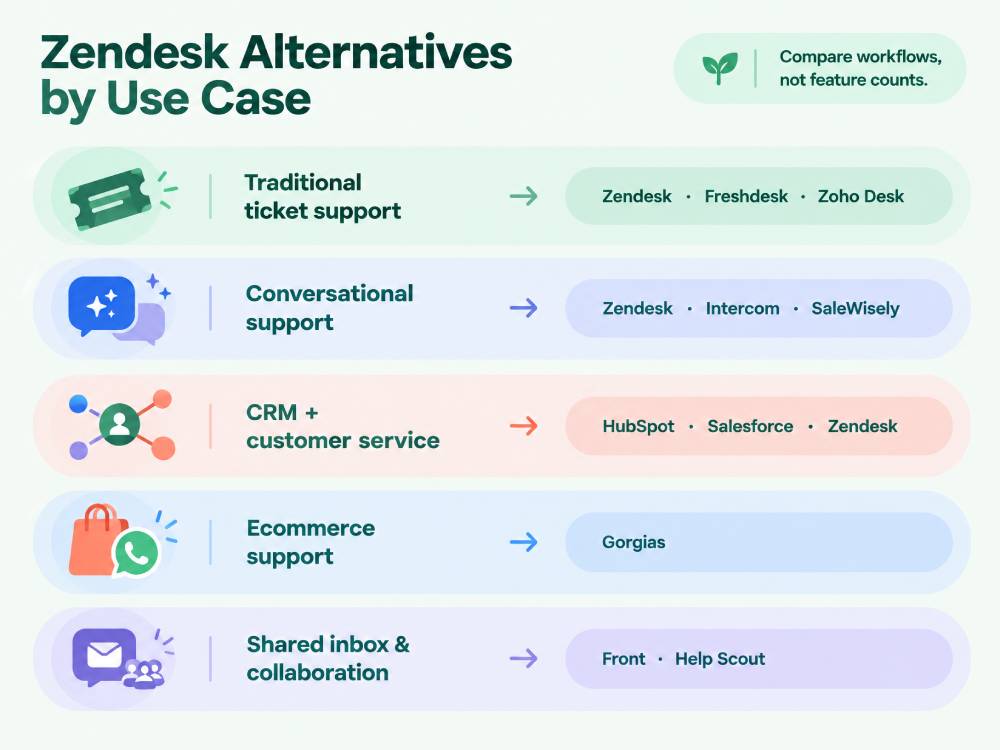
Zendesk vs Competitors by Use Case
Instead of asking which product is the biggest competitor, it is often more useful to compare platforms by customer service use case.
Use Case | Platforms to Consider |
Traditional ticket support | Zendesk, Freshdesk, Zoho Desk |
Conversational support | Zendesk, Intercom, SaleWisely |
CRM + customer service | HubSpot, Salesforce, Zendesk |
Enterprise service operations | Salesforce, Zendesk |
Ecommerce support | Gorgias |
Shared inbox | Front, Help Scout |
B2B customer support | Pylon |
SaleWisely, Zendesk, Intercom, Zoho Desk | |
SaleWisely, Front, Zendesk, Zoho Desk | |
Multiple social and messaging channels | SaleWisely, Zendesk, Intercom |
Multilingual customer conversations | SaleWisely, Intercom, Zendesk |
This use-case approach is more useful than treating every platform as a direct replacement for Zendesk.
How Team Size Changes the Choice
Small Teams
Small businesses usually need to balance functionality with cost and administrative overhead.
A traditional help desk such as Freshdesk or Zoho Desk may make sense for ticket-based support. Help Scout may fit teams that want a simpler support workflow.
For teams whose customers primarily contact them through social media and messaging apps, a platform such as SaleWisely may be relevant.
The key question is whether the team's main workload is tickets or conversations across messaging channels.
Growing Teams
Growing support teams often need:
1. Automation
2. Team routing
3. Knowledge bases
4. Reporting
5. Customer history
6. CRM integration
7. AI assistance
8. Multiple communication channels
At this stage, Zendesk, Freshdesk, Intercom, HubSpot, Front, and Zoho Desk can all become relevant depending on the support model.
Mid-Market and Enterprise Teams
Larger organizations generally have more complex requirements around:
1. Roles and permissions
2. SLAs
3. Reporting
4. Workflow customization
5. Integrations
6. Security
7. Multiple teams or brands
8. Customer data
9. AI governance
Zendesk and Salesforce are particularly relevant in this category, while other platforms may fit specific operating models.
Social and Messaging-First Teams
This is a different category from traditional help desk software.
If customers mostly contact a business through WhatsApp, Instagram, TikTok, Facebook, LINE, or other messaging channels, the team may need a platform designed around those conversations rather than one that simply adds messaging to an existing ticket system.
That is where social- and messaging-focused platforms become relevant.
What Should You Compare When Choosing a Zendesk Alternative?
A useful comparison should go beyond the number of features on a pricing page.
1. How do customers contact you?
Start with your actual customer behavior.
Are customers mainly using:
l Email?
l Website chat?
l Phone?
l WhatsApp?
l Instagram?
l Facebook?
l TikTok?
l Multiple channels?
A platform should fit the channels customers already use.
2. How does pricing scale?
Check whether costs increase with:
1. Agents
2. Seats
3. Contacts
4. Tickets
5. Conversations
6. AI usage
7. Channels
8. Phone usage
9. Automation
10. Storage
Two platforms can have similar starting prices but very different costs at scale.
3. How much automation do you need?
Look beyond the word "AI."
Check whether the platform can actually:
l Answer common questions
l Use a knowledge base
l Route conversations
l Trigger workflows
l Translate messages
l Escalate to humans
l Take actions in connected systems
4. Do you need a CRM or just a help desk?
Some businesses need customer service tightly connected to sales and marketing.
Others simply need a reliable support inbox and ticketing system.
If you already use Salesforce or HubSpot, keeping customer service within that ecosystem may simplify customer data management.
5. How much administration can your team handle?
Enterprise functionality can be valuable, but it can also require more configuration.
Consider who will manage:
l Workflows
l Roles
l Automations
l Reports
l Integrations
l Knowledge bases
l AI configuration
A platform that technically supports a requirement is not necessarily the easiest platform for your team to operate.
Common Mistakes When Comparing Zendesk Alternatives
Comparing only the starting price
A low advertised starting price does not tell you what the final bill will look like after adding AI, channels, additional agents, or usage.
Always compare the pricing model, not just the entry price.
Treating every customer service platform as the same
Zendesk, Intercom, Salesforce, Gorgias, Front, and SaleWisely may all be described as customer service platforms, but they are built around different workflows.
A help desk, CRM, conversational platform, ecommerce support system, and shared inbox are not identical products.
Ignoring customer contact channels
If most customers contact you through WhatsApp or Instagram, choosing a platform based only on email ticketing capabilities can create unnecessary operational work.
Comparing features instead of workflows
A feature checklist can make two platforms look similar.
The more useful question is:
Can our team handle a real customer conversation from first message to resolution without switching between several systems?
That is often where the practical difference appears.
Relying Too Much on Review Scores
Third-party review platforms can be useful when comparing customer service software, but review scores do not necessarily reflect how well a platform fits your team's workflow.
A platform with strong reviews may still be a poor fit if it does not support the channels, integrations, automation, or pricing model your business needs.
For example, G2’s current Help Desk category evaluates a broad range of products, which reinforces the need to compare platforms based on actual requirements rather than review scores alone.
Is Zendesk Still the Right Choice?
Zendesk remains relevant for businesses that need a structured customer service operation with ticketing, routing, automation, knowledge management, analytics, and broader omnichannel capabilities.
Its current customer service plans include support functionality alongside messaging, live chat, AI, knowledge base capabilities, and other service features. (Zendesk pricing)
The question is not whether Zendesk has enough features.
The better question is whether those features match the way your team works.
For a traditional support organization, Zendesk may fit naturally.
For a company centered around conversational support, ecommerce, CRM, B2B communication, or social messaging, another platform may align more closely with its workflow.
How to Choose Between Zendesk and Its Competitors
Before switching or purchasing, answer these five questions:
1. Where do most customer conversations happen?
Email, tickets, phone, live chat, WhatsApp, social media, or a combination?
2. How many people need access?
Compare per-seat pricing with free seats, unlimited seats, or usage-based models.
3. How much AI do you actually need?
Determine whether AI is included, charged per agent, charged per outcome, or purchased through credits.
4. Do you need a CRM?
If customer service needs deep integration with sales and marketing, HubSpot or Salesforce may deserve closer consideration.
5. Is your support operation ticket-first or conversation-first?
This can be one of the most important distinctions.
If your team primarily manages structured support tickets, a traditional help desk may be the natural fit.
If your team manages large volumes of social and messaging conversations, a messaging-focused platform may be more appropriate.
FAQ
Who is Zendesk's biggest competitor?
Freshdesk is one of the closest direct competitors to Zendesk in traditional help desk software.
However, there is no single competitor that is closest across every customer service use case. Salesforce, Intercom, HubSpot, Gorgias, Front, Zoho Desk, Pylon, and SaleWisely compete with Zendesk in different areas.
Is Freshdesk better than Zendesk?
Freshdesk and Zendesk address many of the same traditional help desk requirements, but the better fit depends on your team's workflows, required features, integrations, pricing model, and support channels.
The two should be compared based on your actual requirements rather than a general ranking.
What is the best free alternative to Zendesk?
The answer depends on what you mean by "free."
Some customer service platforms offer free tiers with limits on users or features. Others offer free trials. Some platforms use a different model where the core platform is free but certain usage or AI features are paid.
SaleWisely currently offers its core platform free forever, with unlimited seats, channels, and cloud hosting, while optional AI capabilities use AI credits. (SaleWisely pricing)
Is there a cheaper alternative to Zendesk?
There are several platforms with different pricing models, including Freshdesk, Zoho Desk, Help Scout, Front, and SaleWisely.
However, "cheaper" depends on how many agents you have, which channels you use, ticket or conversation volume, AI usage, and which features you need.
What is the best Zendesk alternative for small businesses?
Small businesses can consider different platforms depending on their support model.
Freshdesk and Zoho Desk are relevant for traditional ticket-based support. Help Scout and Front are relevant for simpler shared communication workflows. Intercom is relevant for conversational support, while SaleWisely is designed around social and messaging-based customer communication.
What is the best Zendesk alternative for WhatsApp?
Businesses that receive a large share of customer communication through WhatsApp should compare platforms based on their WhatsApp integration, automation, team inbox, customer context, and pricing model.
SaleWisely, Zendesk, Intercom, and Zoho Desk can all be considered, but the right choice depends on the broader channel mix and workflow.
Final Thoughts
There is no single Zendesk competitor that replaces it for every type of business.
Freshdesk is a close comparison for traditional help desk software. Intercom focuses more heavily on conversational and AI-powered support. Salesforce and HubSpot connect customer service closely with CRM. Gorgias focuses on ecommerce. Front and Help Scout emphasize collaborative customer communication. Pylon focuses on B2B support.
Specialized platforms also exist for social and messaging-first workflows, ecommerce support, shared inboxes, and B2B communication.
The most useful way to evaluate Zendesk alternatives is therefore not to ask:
"Which company is Zendesk's biggest competitor?"
Instead, ask:
"Which customer service platform fits the way our customers actually communicate with us?"
That question usually leads to a more practical comparison.